
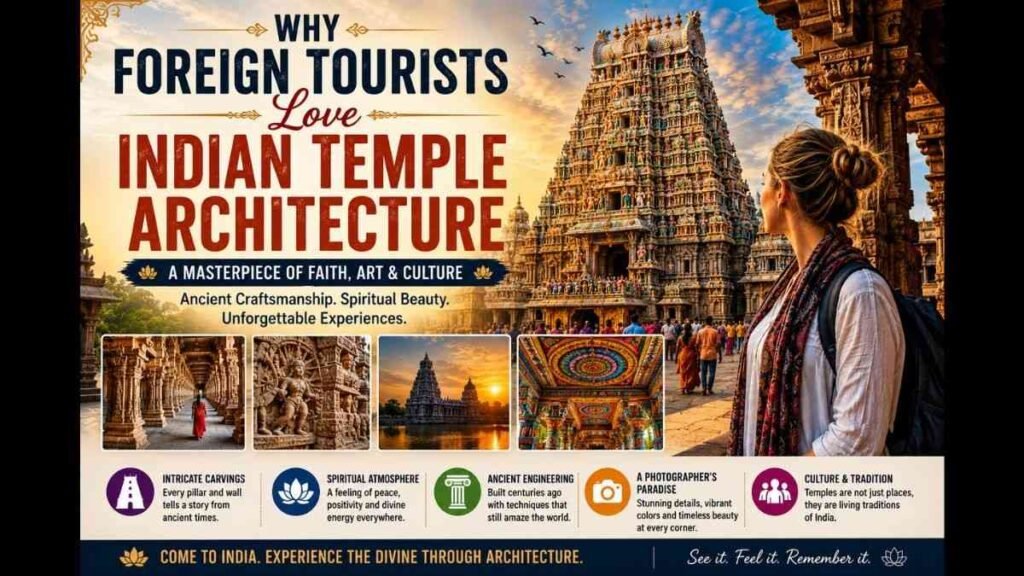
For many international travelers visiting India for the first time, temples become far more than spiritual destinations. They become places of curiosity, emotion, artistic fascination, and cultural discovery. Among all the experiences that leave a lasting impression on foreign visitors, Indian temple architecture often stands out the most.
Travelers from the United States, the United Kingdom, Europe, Australia, and other parts of the world frequently describe Indian temples as visually overwhelming in the best possible way. The intricate carvings, giant towers, detailed sculptures, symbolic artwork, and centuries-old craftsmanship create an experience that feels completely different from modern architecture found in many Western countries.
In 2026, interest in Indian temple architecture is growing rapidly as spiritual tourism, cultural travel, and meaningful travel experiences continue expanding worldwide. Travelers are no longer interested only in luxury vacations or famous landmarks. Increasingly, they want to understand the history, culture, and artistic identity of the places they visit.
Indian temples offer all of these experiences at once.
For many foreign tourists, visiting an Indian temple feels less like entering a building and more like stepping into a living work of art connected to spirituality, history, and human creativity.
The First Reaction Many Foreign Visitors Have
One of the most common reactions international travelers have when seeing Indian temples for the first time is surprise at the sheer amount of detail.
Many visitors expect beautiful structures, but they are often unprepared for:
- hand-carved pillars
- giant temple towers
- intricate sculptures
- colorful ceilings
- symbolic carvings
- massive stone architecture
Unlike modern minimalist buildings, Indian temples often feel visually rich from every angle.
Foreign tourists frequently spend hours observing details that cannot be noticed immediately. Some visitors even compare temple architecture to giant storytelling systems carved into stone.
This feeling of discovery is one reason temple architecture leaves such a strong emotional impact on travelers.
Indian Temples Feel Different From Western Religious Buildings
Many foreign travelers naturally compare Indian temples with churches, cathedrals, monasteries, or historical buildings they have visited in their own countries.
One major difference they notice is the sensory intensity.
Indian temples often combine:
- architecture
- sound
- rituals
- colors
- movement
- community participation
all in one place.
In many Western religious spaces, silence and simplicity dominate the atmosphere. Indian temples, however, often feel alive with activity and emotion.
This combination of spirituality and artistic expression fascinates many international visitors because it feels immersive rather than passive.
The Symbolism Fascinates Travelers
Another reason foreign tourists love Indian temple architecture is the symbolism hidden throughout the structures.
Visitors often discover that:
- carvings represent mythology
- animals symbolize spiritual ideas
- tower designs carry religious meaning
- geometric patterns reflect ancient beliefs
For travelers interested in culture and history, this transforms temple visits into deeper learning experiences.
Many foreign tourists say they become curious not only about the architecture itself, but also about the stories and traditions connected to it.
Temples often encourage visitors to slow down, observe carefully, and ask questions.
Ancient Craftsmanship Feels Almost Impossible
Many travelers are shocked when they learn how old some Indian temples are.
Temples built hundreds or even thousands of years ago still display:
- precise stonework
- balanced engineering
- detailed sculpture
- massive construction
For foreign visitors accustomed to modern construction technology, this level of ancient craftsmanship feels difficult to imagine.
Some travelers become especially fascinated by the fact that many temples were built without modern machines or digital tools.
This creates admiration not only for the architecture, but also for the people and traditions behind it.
South Indian Temple Architecture Leaves Strong Impressions
Many international travelers are especially fascinated by South Indian temple architecture.
Temples in states like:
- Tamil Nadu
- Karnataka
- Andhra Pradesh
are known for:
- giant gopurams
- colorful sculptures
- towering entrances
- detailed carvings
For many first-time visitors, these temple towers become one of the most visually unforgettable sights in India.
The scale itself often surprises travelers.
Some visitors say the temples feel more like entire spiritual cities than individual buildings.
Temple Architecture and Emotional Atmosphere
Foreign tourists often notice that Indian temple architecture is not only visually impressive — it also affects emotional atmosphere.
Features like:
- narrow stone corridors
- giant open courtyards
- sacred lamps
- rhythmic pillars
- symmetrical layouts
can create feelings of:
- calmness
- reflection
- spiritual curiosity
- emotional intensity
Many travelers say temples feel designed not only for visual beauty, but also for emotional experience.
This emotional connection is one reason visitors remember temples long after their trip ends.
Why Photographers Love Indian Temples
Indian temples have become increasingly popular among:
- travel photographers
- documentary filmmakers
- architecture enthusiasts
- cultural journalists
The combination of:
- light
- texture
- stone detail
- rituals
- movement
creates visually powerful scenes.
Photographers often describe Indian temples as endlessly photogenic because every corner contains:
- patterns
- sculptures
- color contrasts
- human emotion
This visual richness performs especially well on:
- YouTube
which has helped increase global curiosity about Indian temple culture.
The Contrast Between Ancient and Modern India
Another thing many foreign tourists find fascinating is the contrast between ancient temple architecture and modern city life.
Visitors often see:
- centuries-old temples surrounded by modern traffic
- ancient rituals continuing in contemporary cities
- traditional carvings beside modern buildings
This coexistence of old and new feels unique to many international travelers.
For some visitors, temples become symbols of how deeply history still remains connected to everyday life in India.
Why Temple Architecture Feels More Human Than Modern Design
Many foreign travelers say Indian temples feel emotionally warmer than modern architecture.
Modern buildings in many parts of the world often focus on:
- efficiency
- minimalism
- functionality
Indian temples, however, often feel deeply human because they include:
- storytelling
- artistic expression
- symbolic meaning
- emotional detail
Travelers frequently say temples feel built with patience and devotion rather than speed.
This difference leaves a strong impression on people who are used to fast modern urban environments.
The Role of Temple Architecture in Spiritual Tourism
As spiritual tourism grows globally, architecture has become one of the biggest reasons travelers visit India.
People who may not consider themselves religious still travel to temples because they are interested in:
- history
- art
- photography
- cultural identity
- emotional atmosphere
Temple architecture acts as a bridge between spirituality and tourism.
For many visitors, architecture becomes the first reason they visit a temple, while emotional experience becomes the reason they remember it.
Famous Temples Foreign Tourists Often Admire
Several Indian temples are especially admired internationally because of their architecture.
These include:
- Meenakshi Temple
- Konark Sun Temple
- Jagannath Temple
- Ramanathaswamy Temple
- Kedarnath Temple
Each temple creates a completely different emotional and visual experience.
Younger Travelers Are Especially Interested
Younger international travelers are increasingly attracted to places that feel:
- authentic
- meaningful
- visually unique
- culturally rich
Temple architecture naturally attracts this generation because it combines:
- history
- emotion
- visual storytelling
- spirituality
- travel photography
Many younger travelers now prioritize experiences over luxury tourism, which has helped spiritual and cultural tourism grow rapidly in India.
Social Media Has Increased Curiosity Worldwide
Social media has dramatically increased international exposure to Indian temple architecture.
Travel videos and photography now regularly showcase:
- temple corridors
- giant towers
- sacred rituals
- sunrise ceremonies
- historical carvings
Many travelers first discover Indian temple architecture online before deciding to visit in person.
However, most visitors later say photographs cannot fully capture the emotional scale and atmosphere of real temple experiences.
Why Temple Visits Feel Memorable to Foreign Tourists
Many international visitors leave temples with memories that feel emotional rather than simply visual.
Visitors often remember:
- the atmosphere
- the sounds
- the smell of incense
- the feeling of standing inside ancient spaces
- the human energy around them
This combination of architecture and emotional atmosphere creates experiences that feel deeply immersive.
For many travelers, Indian temples become one of the most unforgettable parts of visiting India.
Final Thoughts
Indian temple architecture continues fascinating foreign tourists because it offers something many modern travel experiences cannot — emotional depth connected with history, spirituality, craftsmanship, and human expression.
In 2026, as more international travelers search for meaningful cultural experiences, Indian temples continue attracting visitors who want more than sightseeing. They want places that make them feel curiosity, reflection, wonder, and emotional connection.
For many foreign travelers, Indian temple architecture is not only beautiful. It represents a living relationship between art, spirituality, tradition, and community that still exists in the modern world.
That is why these temples continue leaving lasting impressions on people from around the globe.